

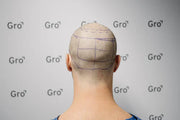







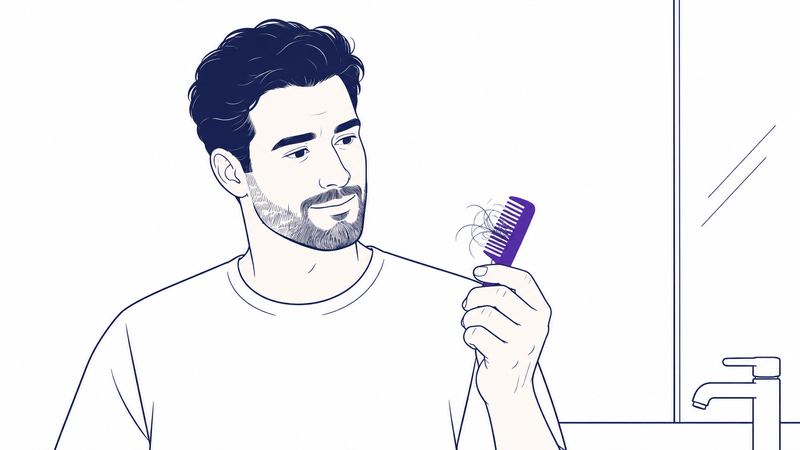
Hair loss is a listed side effect of Mounjaro® (tirzepatide) in New Zealand, and it is usually temporary shedding rather than permanent balding. In the main weight-management trial, about 5% of people taking tirzepatide reported hair loss, compared with about 1% on placebo (1)(2). The shedding is mostly linked to weight loss, through a process called telogen effluvium. If you notice it, speak with your prescribing doctor before changing anything.
Key takeaways
- Hair loss is listed as a less serious side effect in the New Zealand and Australian Consumer Medicine Information (CMI) for Mounjaro (1).
- In the SURMOUNT-1 trial, hair loss was reported by 4.9% to 5.7% of people on tirzepatide, depending on dose, and by 0.9% on placebo (2).
- Women reported hair loss far more often than men in pooled weight-management trials: 7.1% compared with 0.5% (3).
- The usual cause is telogen effluvium, shedding that starts 2 to 4 months after a trigger such as rapid weight loss and settles over 6 to 9 months in most cases (4).
- Telogen effluvium leaves the follicles in place, so hair usually regrows, but it can unmask pattern hair loss that needs a different approach (4).
- Any change to Mounjaro, including stopping it, is a decision to make with your prescribing doctor (1).
Is hair loss a listed side effect of Mounjaro in New Zealand?
Yes. The New Zealand and Australian CMI for Mounjaro lists hair loss among its less serious side effects, alongside effects such as nausea, tiredness and dizziness (1). The same leaflet advises against stopping the medicine suddenly without consulting your doctor (1).
Medsafe gave consent for the Mounjaro KwikPen in December 2025 (5). In New Zealand it is used for type 2 diabetes, for weight management, and for moderate to severe obstructive sleep apnoea in adults with obesity (1). After getting medical advice, you can report a suspected side effect to the Centre for Adverse Reactions Monitoring (CARM) (1).
Many overseas articles say hair loss isn't a listed side effect of Mounjaro. Those articles usually describe the United States, where tirzepatide is sold under two brand names: Mounjaro for type 2 diabetes and Zepbound® for weight management. The US Zepbound prescribing information lists hair loss from the weight-management trials and links it with weight reduction (3). In New Zealand, one brand covers both uses, and the local leaflet includes hair loss.
How common is hair loss on tirzepatide?
About 5 in every 100 people taking tirzepatide for weight management reported hair loss in the main trial, compared with about 1 in 100 on placebo (2). Figures quoted online range from "rare" to "1 in 4", mostly because each measures something different. The table shows where each figure comes from.
| Source | Who was studied | What it found | Flag |
|---|---|---|---|
| SURMOUNT-1, New England Journal of Medicine, 2022 (2) | 2,539 adults with obesity or overweight and without diabetes, over 72 weeks | Hair loss reported by 5.1% on 5 mg, 4.9% on 10 mg and 5.7% on 15 mg, compared with 0.9% on placebo | Randomised and placebo-controlled. Counts reported side effects, not dermatologist diagnoses. |
| Zepbound prescribing information, US FDA (3) | Pooled weight-management trials of tirzepatide | Hair loss reported by 7.1% of women and 0.5% of men, compared with 1.3% and 0% on placebo | US document. Split by sex, not by type of hair loss. |
| SURMOUNT-5, New England Journal of Medicine, 2025 (6) | Adults with obesity taking tirzepatide or semaglutide, head to head, over 72 weeks | Hair loss reported with both medicines | Not designed to compare side effects between the two. |
| The BMJ, 2026 (7) | Adults with type 2 diabetes starting a GLP-1 medicine or another diabetes medicine, in one US health system | 6.91 new cases of hair loss per 1,000 person-years with GLP-1 medicines, compared with 5.04 with SGLT-2 inhibitors (hazard ratio 1.37), mainly non-scarring hair loss | Observational; all GLP-1 medicines grouped. The reported "37% higher" is relative; absolute rates were low in both groups. |
| Obesity Surgery, 2021 (8) | Pooled studies of people after weight-loss surgery | Hair loss in about half or more of patients | Surgery adds its own triggers, so not comparable to medication rates. Shows how closely shedding tracks major weight loss. |
| "Up to 1 in 10" (UK and European leaflets) (9) | A frequency band, not a study | "Common" means a side effect may affect up to 1 in 10 people, which covers anything from 1 in 100 to 1 in 10 | Often misread as a measured rate of 10%. |
| "1 in 4" and "25% to 33%" (online articles) | No published study identified | An unnamed study and one clinician's estimate | Couldn't be traced to published data. Not used here. |
This article uses two figures for hair loss on tirzepatide: about 5% and 7.1%. They describe different groups. The first covers everyone in SURMOUNT-1, while the second covers women only, across pooled trials, and women reported hair loss far more often than men (2)(3).
Why can tirzepatide lead to hair shedding?
The leading explanation is telogen effluvium: a temporary change in the hair growth cycle after a shock to the system, such as rapid weight loss, illness, surgery or a change in diet (4). The US prescribing information describes hair loss reports with tirzepatide as associated with weight reduction (3). A direct effect of tirzepatide on hair follicles hasn't been shown, and hasn't been ruled out.
Normally, about 85% of scalp follicles are growing and about 15% are resting (4). Each resting phase lasts about 4 months before a new hair pushes the old one out. After a significant shock, up to 70% of growing hairs can switch to resting at once, which is why shedding arrives as a wave, months after the trigger (4). Our guide to the hair growth cycle explains these phases in more detail.
Several things can add to the effect while taking tirzepatide:
- How quickly weight comes off. Weight loss and changes in diet are both recognised triggers of telogen effluvium (4).
- Eating less overall. A smaller appetite can make it harder to get enough protein, iron and other nutrients, and iron deficiency is itself a recognised trigger (4).
- Other triggers at the same time. Illness, surgery, psychological stress, thyroid changes and stopping the contraceptive pill can all cause shedding too (4).
When does Mounjaro hair loss start, and how long does it last?
Shedding from telogen effluvium usually becomes noticeable 2 to 4 months after the trigger, then tapers back to normal over 6 to 9 months in most cases (4). With tirzepatide, that means shedding is more likely to appear a few months into treatment than in the first weeks. Losing up to about 100 hairs a day is a normal part of the hair cycle (4).
| Stage | Typical timing | What you may notice |
|---|---|---|
| Trigger | When weight loss or a change in eating begins | Nothing yet. Affected hairs move into the resting phase. |
| Shedding starts | 2 to 4 months after the trigger | More hair on your brush, pillow or in the shower drain |
| Peak | Several months in | Hair feels thinner all over the scalp |
| Settling | Tapers over 6 to 9 months in most cases | Less shedding, and short new hairs, often along the hairline |
| Still shedding after 6 months | Known as chronic telogen effluvium | Worth a medical review |
Does hair grow back after Mounjaro hair loss?
Usually, yes. Hair loss from telogen effluvium is non-scarring: the follicles stay in place, and regrowth usually follows once the trigger settles, though recovery can be incomplete in some people (4). So for most people, this kind of hair loss is temporary rather than permanent.
Dr Adam Cho, Medical Director at Gro Clinics, explains that in this kind of shedding the hair roots aren't permanently damaged, and that hair usually grows back once weight loss slows and nutrition improves.
Two situations need a closer look:
- Shedding that lasts beyond 6 months. This is called chronic telogen effluvium, and the cause is worth investigating (4).
- Thinning that stays in one pattern. Telogen effluvium can unmask a genetic tendency to pattern hair loss: female pattern hair loss in women, or male pattern hair loss in men (4). Pattern hair loss follows a different course and is treated differently, so it's worth having assessed. Our article on whether hair loss can be reversed explains why.
Why do women report more hair loss on Mounjaro?
In pooled tirzepatide weight-management trials, 7.1% of women reported hair loss compared with 0.5% of men (3). The trials don't explain the gap, but several known factors may contribute.
- Visibility. People with longer, thicker hair tend to notice shed hairs more, which is one reason chronic shedding is reported more often in women (4).
- Iron and other nutrients. Iron deficiency is a recognised trigger of telogen effluvium (4). After weight-loss surgery, hair loss was more common in younger women and in people with low zinc, folic acid and ferritin, the body's iron store (8).
- Overlapping triggers. Childbirth and stopping the contraceptive pill can both cause shedding, and may coincide with treatment (4).
- Female pattern hair loss. Signs include a widening part and thinner hair on the front and top of the scalp (4). Repeated episodes of telogen effluvium can sometimes evolve into female pattern hair loss (4).
For women, an assessment usually starts with blood tests and a close look at where the thinning is, because several causes can overlap. Our article on hair so thin you can see your scalp covers these causes in more depth.
Is it shedding or pattern hair loss?
Telogen effluvium causes shedding across the whole scalp, while pattern hair loss causes gradual thinning in typical areas: the part line in women, and the temples and crown in men (4). The two can happen together, so a change that persists after shedding settles is worth checking.
| Feature | Shedding (telogen effluvium) | Pattern hair loss |
|---|---|---|
| Onset | Fairly sudden, 2 to 4 months after a trigger | Gradual, over months or years |
| Where | All over the scalp | Women: a widening part, thinner hair at the front and top. Men: receding temples, thinning crown |
| What you notice | Many whole hairs falling, often with a small club-shaped bulb at the root | Hairs becoming finer and shorter in the affected areas |
| Course | Settles over 6 to 9 months in most cases | Tends to progress over time |
| Typical next step | Time, good nutrition and a check for deficiencies | A medical assessment to discuss treatment |
Our guide to the early signs of balding shows what pattern hair loss looks like in men.
Can you prevent hair loss when taking Mounjaro?
Not always. Shedding linked to weight loss can happen even with good habits, but some steps may lower the risk and help you catch a different cause early.
- Tell your prescribing doctor. They can look at your overall progress, and any change to your medication or dose is their decision.
- Eat enough, especially protein. DermNet recommends a nutritious diet with plenty of protein, fruit and vegetables while shedding settles (4). Dr Cho notes that crash dieting makes shedding more likely, and that a dietitian can help plan meals when your appetite is low.
- Ask your GP about blood tests. Thyroid function, iron, vitamin B12 and folic acid are worth checking, and any problem found can be corrected (4). Our article on which vitamin deficiencies cause hair loss covers the common ones.
- Be wary of high-dose supplements. Biotin has only shown a benefit for hair in people with a deficiency or an underlying condition (10), and high doses can interfere with some laboratory blood tests (11). Tell your doctor about any supplements before a blood test.
- Handle your hair gently. Avoid over-vigorous brushing and combing while it is shedding (4).
How to thicken hair after weight loss. Hair lost to telogen effluvium usually regrows by itself, and the scalp tends to thicken back up as shedding tapers (4). Time and good nutrition do most of the work; see our guide to foods that support hair growth. If thinning persists, the right treatment depends on the cause, which is why an assessment comes first.
See a doctor sooner if you notice:
- shedding that continues beyond 6 months
- round patches of complete hair loss
- a widening part, receding temples or thinning at the crown
- redness, scaling, pain or itch on the scalp
- other new symptoms, such as ongoing tiredness
Questions to ask your GP or prescribing doctor:
- Does my shedding look like telogen effluvium, or could it be pattern hair loss?
- Should I have blood tests, such as iron studies, thyroid function, vitamin B12 and folate?
- Is my food intake, especially protein, enough while my appetite is low?
- If the shedding hasn't settled in 6 months, who should I see next?
How Gro approaches thinning after weight loss
Weight-loss medication stays with the doctor who prescribes it. Gro's focus is the hair: working out which kind of hair loss it is before suggesting anything.
Active shedding from telogen effluvium usually settles by itself, so the advice is often to give it time while your GP checks for deficiencies. Where shedding has unmasked pattern hair loss, the treating doctor talks through the options, which can include Prescription Haircare after a consultation with a doctor to assess suitability. A hair transplant is only considered once shedding has settled and the pattern of loss is clear, because until then it isn't possible to judge how much hair is stable.
In New Zealand, hair assessments take place at Gro Clinics Auckland, where the treating doctor reviews each case before any plan is agreed. Sometimes the right advice is simply to wait while shedding settles.
Frequently asked questions
Will hair grow back after stopping Mounjaro?
Hair usually regrows whether or not you continue Mounjaro, because telogen effluvium settles as its trigger eases, often once weight loss slows (4). Any change to the medication is a decision for your prescribing doctor (1). If shedding is still heavy after 6 months, ask for a review.
Does Mounjaro cause more hair loss than Ozempic?
There's no clear answer yet. In SURMOUNT-5, the first published head-to-head trial of tirzepatide and semaglutide (the active ingredient in Ozempic® and Wegovy®), hair loss was reported with both medicines, and the trial wasn't designed to compare side effects (6). Comparing separate trials is unreliable because the people, doses and durations differ. With either medicine, hair loss is mostly linked to weight loss itself, and the choice of medicine sits with your prescribing doctor.
Should I stop taking Mounjaro if my hair is falling out?
Talk to your prescribing doctor first; the CMI advises against stopping suddenly without their advice (1). Shedding linked to weight loss is usually temporary, and your doctor can check for treatable causes such as low iron or thyroid changes (4).
Does a higher dose of Mounjaro cause more hair loss?
The trial data doesn't show a steady rise with dose. In SURMOUNT-1, hair loss was reported by 5.1% on 5 mg, 4.9% on 10 mg and 5.7% on 15 mg, against 0.9% on placebo (2). The US prescribing information links hair loss with weight reduction rather than dose (3), which is one reason dose decisions sit with your prescribing doctor.
Do biotin supplements help with Mounjaro hair loss?
Probably not, unless you're low in biotin. A review found biotin helped hair only in people with a deficiency or an underlying condition (10), and high doses can interfere with some laboratory blood tests (11). A blood test is a better starting point than a supplement.
Does Mounjaro hair loss affect men?
Yes, though men reported it far less often in trials: 0.5% of men compared with 7.1% of women in pooled weight-management studies (3). In men, shedding can unmask male pattern hair loss (4). If receding temples or a thinning crown remain after shedding settles, our guide to the signs of balding is a useful next read.
Can Mounjaro for type 2 diabetes cause hair loss?
It can. The CMI lists hair loss as a side effect without limiting it to one use of Mounjaro (1), though most published hair loss figures come from weight-management trials. In adults with type 2 diabetes, a 2026 study in The BMJ found GLP-1 medicines as a group were linked with a modestly higher rate of non-scarring hair loss than two other diabetes medicines (7).
Can I have a hair transplant while taking Mounjaro?
It may be possible, but timing and safety both need planning with your doctors. A hair transplant moves existing follicles to thinning areas, so it is planned around stable hair loss and waits until shedding has settled. Tirzepatide slows how quickly the stomach empties, and the CMI asks you to tell any doctor, surgeon or anaesthetist that you are using Mounjaro (1). Australian and New Zealand anaesthesia guidance sets out how to plan sedation for people on these medicines (12). Tell both your prescribing doctor and the treating doctor that you take Mounjaro. Our hair transplant page explains what the procedure involves.
How long does hair shedding on GLP-1 medicines last?
Shedding usually starts 2 to 4 months after the trigger and tapers over 6 to 9 months in most cases, whether the weight loss came from tirzepatide, semaglutide or another cause (4). Shedding beyond 6 months is worth a medical review.
In summary
Hair loss on tirzepatide is listed in the local CMI, affects a minority of people in trials, and is most often telogen effluvium linked to weight loss (1)(2)(4). Keep your prescribing doctor informed, give shedding time to settle, and look after your nutrition. Thinning that lasts beyond 6 months, or a pattern that remains as shedding eases, deserves its own assessment.
Thinning that hasn't settled?
A free 15-minute Discovery Call is a straightforward way to ask general questions about your hair and understand the next steps with the Gro Clinics Auckland team. It is not a medical consultation or suitability assessment. Where appropriate, the team can help arrange an in-clinic consultation with a personalised treatment plan.
Book a free discovery callMedically reviewed by Dr Leo Chong, Hair Transplant Doctor, Gro Clinics Auckland. MBChB, University of Auckland. Medical Council of New Zealand registration: 75673.
References
- Eli Lilly Australia and Eli Lilly and Company (NZ). Mounjaro KwikPen Consumer Medicine Information (Australia and New Zealand). September 2026. https://www.medsafe.govt.nz/consumers/cmi/m/Mounjaro.pdf Manufacturer leaflet, approved by regulators. Lists side effects without frequencies.
- Jastreboff AM, Aronne LJ, Ahmad NN, et al. Tirzepatide once weekly for the treatment of obesity (SURMOUNT-1). New England Journal of Medicine. 2022;387:205-216. https://www.nejm.org/doi/full/10.1056/NEJMoa2206038 Randomised controlled trial, 2,539 adults without diabetes. Manufacturer-funded. Hair loss counted as a reported adverse event.
- US Food and Drug Administration. Zepbound (tirzepatide) prescribing information. 2026. https://www.accessdata.fda.gov/drugsatfda_docs/label/2026/217806s042lbl.pdf US regulatory document. Sex split from pooled weight-management trials.
- DermNet. Telogen effluvium. Updated November 2019. https://dermnetnz.org/topics/telogen-effluvium New Zealand dermatology reference, reviewed by a dermatologist editor.
- Medsafe. Product detail: Mounjaro KwikPen (tirzepatide), consent given 22 December 2025. https://www.medsafe.govt.nz/DbSearch/ProductDetail?Product_id=26392
- Aronne LJ, Horn DB, le Roux CW, et al. Tirzepatide as compared with semaglutide for the treatment of obesity (SURMOUNT-5). New England Journal of Medicine. 2025. https://www.nejm.org/doi/full/10.1056/NEJMoa2416394 Head-to-head trial. Not designed to compare side effects. Manufacturer-funded.
- Risk of hair loss associated with glucagon-like peptide-1 receptor agonists in adults with type 2 diabetes: target trial emulation. The BMJ. 2026;394:e100077. https://pubmed.ncbi.nlm.nih.gov/42486607/ Observational study in one US health system. All GLP-1 medicines grouped. Type 2 diabetes only.
- Zhang W, Fan M, Wang C, et al. Hair loss after metabolic and bariatric surgery: a systematic review and meta-analysis. Obesity Surgery. 2021;31(6):2649-2659. https://pmc.ncbi.nlm.nih.gov/articles/PMC8113177/ Surgical population with additional triggers. Mostly self-reported hair loss.
- European Medicines Agency. Mounjaro: EPAR product information. https://www.ema.europa.eu/en/medicines/human/epar/Mounjaro European leaflet. Uses frequency bands rather than measured rates.
- Patel DP, Swink SM, Castelo-Soccio L. A review of the use of biotin for hair loss. Skin Appendage Disorders. 2017;3(3):166-169. https://pmc.ncbi.nlm.nih.gov/articles/PMC5582478/ Small, case-based evidence base.
- US Food and Drug Administration. UPDATE: The FDA warns that biotin may interfere with lab tests. 2019. https://www.fda.gov/medical-devices/safety-communications/update-fda-warns-biotin-may-interfere-lab-tests-fda-safety-communication
- Australian and New Zealand College of Anaesthetists. Clinical practice recommendations for patients taking GLP-1 receptor agonists. https://www.anzca.edu.au/safety-and-advocacy/standards-of-practice/clinical-practice-recommendations-regarding-patients-taking-glp-1
This article is general information only and is not medical advice. It does not replace an individual assessment by a qualified practitioner. Decisions about Mounjaro or any other prescribed medicine should be made with your prescribing doctor.
Gro Clinics does not prescribe, supply or sell tirzepatide.
Results referenced from clinical studies are population-level findings and do not necessarily reflect outcomes any other individual may experience.
Prescription haircare and regenerative treatments are available following a consultation with a doctor to assess suitability.
Hair transplantation is a medical procedure involving the extraction and placement of follicles. It carries risks, including infection, bleeding, scarring and the possibility that the result may not meet expectations. Individual results and recovery vary. This content was prepared with reference to the Medical Council of New Zealand's statement on advertising.
Mounjaro® and Zepbound® are registered trademarks of Eli Lilly and Company. Ozempic® and Wegovy® are registered trademarks of Novo Nordisk A/S. Gro Clinics has no affiliation with either company.