






Skip to content
Related Blogs
Your Hair Transplant Timeline: What to Expect Before, During and After

Stepping into the world of hair transplants can be both exciting and daunting. In this instalment of Hair Loss 101, we're giving you a behind-the-scenes tour of what to expect when you choose Gro C...

Hair Loss 101: Exploring FUE vs PFP Hair Transplant Techniques

Hello again in our Hair Loss 101 series! Today, we're venturing into the fascinating world of hair transplant techniques. With various methods out there, it can be a bit like navigating a maze. Let...

Related Blogs
Hair Loss 101: Decoding DHT - The Hidden Culprit Behind Hair Loss

Welcome back to our Hair Loss 101 series, where we unravel the mysteries of hair loss, one strand at a time! Today, we're starting at the root of the problem – quite literally. Let's talk about DHT, the secret saboteur behind hair loss.

How Hair Grows: Anagen, Catagen, Telogen & Exogen Hair Phases

Ever pondered over what’s happening atop your head? We're talking about the mysterious world of hair growth. It's time to untangle the science behind those luscious locks and discover what makes them grow!

Related Blogs
Why Choose Gro – What To Look for in a Hair Transplant

What would it mean if you got a bad hair transplant? Hair standing unnaturally straight up, poor hair follicle survival rate, scarring, pain, damage to the donor area ruining the possibility of a future transplant… the list goes on.

How To Prepare For Your Gro Hair Transplant

Hair loss is a big deal for many men. Losing your hair can make you feel older than you are and create feelings of frustration, anxiety and depression. Loss of confidence and self-esteem can also have consequences for your relationships and career prospects.

0

Your cart is empty

Continue shopping
Back to all blogs

Castor Oil for Hair Loss: Does It Actually Work

Castor Oil for Hair Loss: Does It Actually Work

Jump To

    Key Takeaways

    • Castor oil is a type of vegetable oil that comes from the castor bean.
    • There is no strong evidence that castor oil may help regrow hair, contribute to hair restoration or help reduce hair loss.
    • Side effects of using castor oil for hair may include scalp irritationclogged poresdryness and eye irritation.
    • Benefits of castor oil for hair may include moisturising hairpotentially contributing antioxidants, and potentially contributing to anti-inflammation.
    • To apply castor oil to your hair, consider sectioning off your hair into the parts you want to apply oil to. Then, apply the oil by massaging it into your hair. Leave it on for 2 hours before washing it off.
    • For more information about treatments designed for long-term results, consider booking a free 15-minute discovery call with a hair growth advisor.

    Castor oil is a commonly adopted approach for hair loss and thinning hair, typically used to moisturise the scalp and reduce breakage. While no clinical trials have proven the effectiveness of castor oil, some people have found it anecdotally useful for hair care.

    The following article will go through the potential benefits of castor oil for hair and how to apply it safely and effectively.

    Note that this information is general in nature and does not constitute medical advice. Individual results may vary.

    What is Castor Oil?

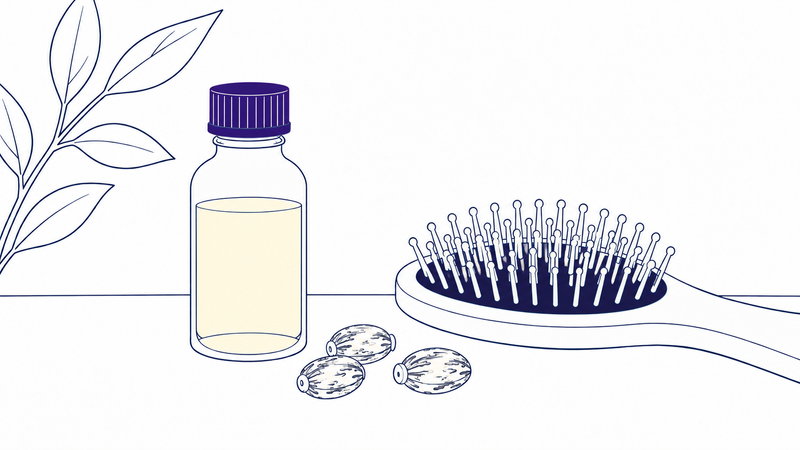
    Castor oil is a type of vegetable oil that is extracted from the seeds of the Ricinus communis plant, also known as the castor bean. It is a thick, pale-yellow liquid rich in ricinoleic acid, which makes it most commonly used as a laxative.

    This acid also gives castor oil moisturising and anti-inflammatory qualities, which are sometimes used in skin care, hair care, and lubrication.

    Does Castor Oil Regrow Lost Hair?

    There is no published scientific evidence that castor oil may help regrow lost hair, contribute to hair restoration, or help reduce hair loss. A study found that 'There is weaker evidence for castor oil improving hair quality by increasing hair luster, and no strong evidence supporting its use for hair growth or treatment of infestation.'

    For treatments designed to improve hair density and coverage, book a free 15-minute discovery call with a hair growth advisor.

    Side Effects and Precautions

    Castor oil is a thick, sticky substance that may cause varying reactions from person to person. Potential side effects of using castor oil for hair may include:

    • Allergies: Some people may have an allergic reaction to castor oil. It is recommended to contact a registered health practitioner to check whether castor oil is suitable for your individual circumstances.
    • Scalp irritation: Some people may develop a rash or show signs of itching, burning and redness when they apply castor oil to their scalp.
    • Clogged pores and buildup: The thickness of castor oil may cause an increased build-up on the scalp and hair, which may trap dirt, dead skin and other substances. This may also worsen dandruff, folliculitis or make hair look more greasy and flat.
    • Dryness: When castor oil is left on for too long, it may dehydrate certain hair types or contribute to a more tangled, 'felted' appearance.
    • Eye irritation: If you accidentally put castor oil in or near your eyes, it may cause burning, redness or other discomfort.
    • Hair Felting: According to a 2017 study, castor oil may also contribute to hair felting, a condition where the hair tangles, twists and compacts into a dense, hard and irreversible mass.

    If you experience any adverse reactions, consider seeking medical advice immediately.

    How Castor Oil May Improve Hair Health

    Castor oil is rich in several minerals and nutrients that may potentially assist in some factors of hair health. Potential benefits include:

    1. Moisturised Hair

    A 2022 study found that castor oil may contain ricinoleic acid. It may work as a natural moisturiser, which may also seal in your hair's natural oils. The acids may also nourish your hair follicles, boost its shine and help reduce breakages and split ends.

    2. Antioxidants

    The castor oil plant may contain antioxidants, according to a 2022 study. These may help combat free radicals. This may reduce inflammation tied to oxidative stress.

    3. Anti-inflammatory

    As the ricinoleic acid found in castor oil may inhibit inflammatory pathways, the oil may have a mild anti-inflammatory effect, according to a study from 2000. This may help reduce, but not treat, inflammation.

    How to Apply Castor Oil

    Whilst Gro Clinics may not recommend castor oil as a treatment to improve hair growth or density, some individuals may still choose to include it in their haircare routine. If so, it's important to use it safely and appropriately.

    Only apply castor oil 1–2 times per week. Follow these steps to apply castor oil to your hair:

    1. Clothing: To reduce staining your current clothes from spreading oil, wear an old t-shirt or other items you don't mind getting dirty.
    2. Hair prep: Section off your hair into the parts you intend to apply oil to. This will make it easier to massage it into the follicles. You may also want to consider putting on rubber gloves to make it easier to clean up, and to massage the oil into your scalp.
    3. Apply the oil: Apply the castor oil into each section of your hair by massaging it into your scalp. You may use a comb to ensure even coverage. It should not be soaked through with oil, only enough to make your hair moist.
    4. Shower: Put on a shower cap and ensure all your hair is inside it. Then, clean off any oil from your hands, shoulders, and body. Be sure to wash your face of any oil as well.
    5. Wait two hours: Leave your shower cap on for two hours. This may give the oil enough time to settle on your scalp and hair.
    6. Wash your hair: Once the two hours have passed, you may wash your hair with shampoo and conditioner.

    If you experience any side effects, remove the castor oil immediately and seek medical advice.

    Applying Castor Oil on Brows and Lashes

    Be extremely cautious when applying castor oil to your eyebrows or eyelashes. A clean eyelash brush, mascara wand or clean Q-tip may be able to make the application easier. Once you have found a wand, you may apply castor oil by:

    1. Wash your face gently and pat it dry.
    2. Pour a small amount of castor oil into a small container, like a cup or a bowl. The amount of oil you will need depends on the thickness of your eyebrows.
    3. Dip your brush, Q-tip or wand into the oil and let the excess drip back into the bowl.
    4. Lightly rub the brush over each eyebrow to coat the hair. Make sure the oil does not drip down into your eyes.
    5. Depending on your preferences, you may keep the oil on for a few hours or leave it on overnight.
    6. When you are ready to remove it, simply wash your face as usual.

    If you experience any side effects, remove the castor oil immediately and seek medical advice.

    Hair Growth at Gro Clinics

    At Gro Clinics, our hair restoration approach is performed by registered health practitioners. We take a supported approach to hair restoration designed for natural-looking results and a gradual improvement over time.

    Our hair transplant procedures are performed by registered doctors and are designed for long-term results. Individual results may vary. A consultation is required to determine suitability. Our services include:

    Castor Oil for Hair Loss FAQs

    Is there clinical evidence that castor oil regrows hair?

    No, there is currently no clinical or scientific evidence that castor oil can regrow hair or generally improve hair health.

    Can you put castor oil in your hair every day?

    No, daily use of castor oil is not recommended, as overuse may lead to sticky hair, buildup, greasiness, and potentially matting over time. It may be more effective only to apply castor oil 1–2 times per week.

    Which is better for your hair, rosemary oil or castor oil?

    Neither rosemary nor castor oil is 'better' for your hair than the other, as each substance may contain different benefits for your hair.

    Rosemary oil may help improve scalp health when applied, while castor oil may be more appropriate to support hair moisture.

    Can castor oil clog hair follicles?

    Yes, when used in excess, especially on oily or fine hair types, castor oil may increase the risk of clogging hair follicles. Remember to wash out castor oil two hours after applying it to reduce accumulation, product buildup, and more.

    Can I leave castor oil in my hair for 2 hours?

    Yes, you may leave castor oil in your hair for 1–2 hours. In fact, this is the recommended time to apply castor oil, as any longer may risk clogging hair follicles.

    Does castor oil work for hair loss?

    No, there is no evidence that castor oil may help reduce or assist in hair loss and hair regrowth. As a hair solution, it is more applicable for potentially supporting moisture and anti-inflammatory properties.

    Does castor oil go bad?

    Yes, castor oil typically has an expiry date of 1–2 years, or 6–12 months after it is opened. While castor oil does not spoil like food, it does become rancid through oxidation, and will not be safe to apply to your hair any longer.

    Ready to book a consult?

    Book a consult

    Ready to explore your options?

    If you're considering hair restoration, you can book a 15-minute virtual information session with a trained Gro Clinics consultant.

    We'll walk you through the process, answer general questions, and explain next steps if you're interested in an in-clinic assessment. This call is for general information only and not a medical consultation.

    Looking for prescription telehealth? Book here

    Prefer a phone call?

    CALL US INSTEAD

    Prefer a phone call?

    CALL US INSTEAD
    Book Now
    IMPORTANT INFORMATION

    Hair Transplant Procedure Risk & Recovery Information

    This document provides general information about hair transplant procedures, including associated risks and recovery. It is intended for public access and does not replace a clinical consultation with a registered medical practitioner. All procedures at Gro Clinics are performed by registered medical practitioners. Individual outcomes, risks, and recovery timelines vary. Speak with your Gro doctor for information specific to your situation.

    1. What Is a Hair Transplant Procedure?

    A hair transplant is a medical procedure in which hair follicles are extracted from a donor area (typically the back or sides of the scalp) and implanted into areas experiencing hair thinning or loss. At Gro Clinics, this is performed using the Follicular Unit Extraction (FUE) technique.

    The procedure involves the use of local anaesthetic, small circular incisions to extract individual follicular units, and their implantation into the recipient area. It is performed under sterile conditions by a registered medical practitioner.

    Hair transplants are a higher risk non-surgical cosmetic procedure. They require careful consideration, a thorough clinical consultation, and informed decision-making. This document is designed to support that process.

    2. Alternative Options

     hair transplant is not the only option for addressing hair loss. Alternatives include, but are not limited to:

    • Hairpieces or hair systems
    • Prescription medications such as minoxidil or finasteride (subject to clinical assessment and prescription)
    • Other hair restoration procedures such as FUT (Follicular Unit Transplantation)
    • No treatment - hair loss is a natural variation and does not require medical intervention

    Your Gro doctor will discuss all relevant options with you during your consultation. A hair transplant may not be appropriate for everyone.

    3. Common Side Effects

    The following side effects are commonly experienced following a hair transplant procedure. They are generally temporary and resolve with time and appropriate aftercare.

    Pain and Discomfort - Discomfort is common during and after the procedure. The degree varies between individuals. Local anaesthetic is administered to manage pain during the procedure.

    Swelling - Swelling of the forehead or eyelids may develop and usually resolves within approximately one week.

    Minor Bleeding and Bruising - Spot bleeding may occur at the donor or recipient site and is typically controllable with pressure.

    Redness or Inflammation - Redness in the implanted area usually resolves within 3 months but may persist for up to 6 months or longer in some individuals.

    Crusting and Scabbing - Small scabs may form in the recipient area, typically resolving within 7-10 days.

    Itching, Numbness or Tingling - These sensations may occur and typically resolve within 6 to 9 months. In rare cases, nerve-related numbness or discomfort may persist for longer.

    Ingrown Hairs - Ingrown hairs are possible as transplanted follicles regrow.

    Pigmentation Changes - Temporary darkening or lightening of the skin in treated areas may occur, usually resolving within months.

    Telogen Effluvium (Shock Loss) - Temporary shedding of native (non-transplanted) hairs may occur following the procedure and usually resolves over time.

    4. Less Common and Rare Complications

    The following complications are less common but possible. Some may require additional medical treatment.

    Infection / Folliculitis - Infection risk is inherent to any procedure involving incisions. Folliculitis (inflammation of hair follicles) may occur and will be monitored. In rare cases, further medical intervention may be required.

    Scarring - FUE involves small circular incisions which may leave tiny white scars in the donor area. Hypertrophic or keloid scarring is rare but possible, depending on individual healing.

    Poor Graft Growth - In some cases, transplanted grafts may not grow as expected. Factors including smoking, underlying medical conditions, and non-compliance with aftercare can affect graft survival. There is no guarantee of complete or uniform growth.

    Overharvesting and Donor Area Thinning - Excessive removal of grafts may lead to noticeable thinning in the donor area, particularly in individuals with limited donor hair.

    Poor Angulation or Unnatural Appearance - If grafts are not implanted at the correct angle, direction, or density, hair may grow in an unnatural pattern. Corrective procedures may be required.

    Reaction to Anaesthetics or Medications - Allergic reactions to local anaesthetics or other medications used during the procedure may occur, ranging from mild to severe.

    Cysts - Small, benign cysts may form in the recipient area if hair follicles become trapped under the skin.

    Persistent Redness or Visible Extraction Sites - Some individuals, particularly those with fair skin, may experience prolonged redness or visible extraction marks beyond the usual healing period.

    Prolonged Swelling - While swelling typically resolves within a week, in rare cases it may persist for longer.

    Skin Necrosis (Very Rare) - Poor blood supply or excessive trauma may lead to localised skin death (necrosis). This risk is higher in smokers or individuals with vascular conditions.

    Excessive Scarring (Very Rare) - While FUE is associated with minimal scarring, some individuals may develop more noticeable scarring due to individual differences in healing.

    Need for Further Procedures - In some cases, corrective surgery or additional sessions may be required to refine the outcome or address areas of poor growth.

    5. Recovery Information

    Recovery from a hair transplant requires time and careful aftercare. The following is general guidance - your Gro doctor will provide specific post-operative instructions tailored to your procedure.

    Immediate Post-Procedure (Days 1-7)

    • Swelling, redness, and tenderness in both donor and recipient areas is expected
    • Small scabs will form and should not be picked or scratched
    • Strenuous physical activity should be avoided
    • Direct sun exposure to the scalp should be avoided
    • You may need time away from work depending on the nature of your role

    Weeks 2-4

    • Scabbing typically resolves by day 7-10
    • Some transplanted hairs may shed - this is normal (telogen effluvium) and does not indicate failure
    • Continued avoidance of strenuous activity is recommended

    Months 3-12

    • Initial hair regrowth typically begins around 3 to 4 months post-procedure
    • Noticeable improvements in thickness and density are generally visible from around 6 months
    • Full results are typically visible around 12 months post-procedure
    • In some cases, results may continue to improve up to 18 months

    Recovery timelines vary between individuals. Factors including age, general health, the size of the procedure, and adherence to aftercare instructions all affect how quickly you heal and how results develop.

    6. Limitations and Important Considerations

    • A hair transplant does not prevent future hair loss. Hair loss may continue in untreated areas. Ongoing medical treatments such as finasteride or minoxidil may be recommended to help maintain results.
    • There is no guarantee of permanent, complete, or uniform hair restoration. Outcomes depend on factors including genetics, age, health, hair characteristics, and adherence to aftercare.
    • Additional sessions may be required. Depending on ongoing hair loss or desired density, further procedures may be needed in the future.
    • 90% graft survival is a general expectation, not a guarantee. Individual graft survival rates vary and cannot be predicted with certainty in advance.
    • Results take time. Full results are typically not visible until 12 months post-procedure. Assessing outcomes before this point may not reflect the final result.

    7. Who May Not Be Suitable for a Hair Transplant

    A hair transplant is not appropriate for everyone. Your Gro doctor will assess your suitability during a clinical consultation. Factors that may affect suitability include:

    • Insufficient donor hair density
    • Certain medical conditions or medications
    • Active scalp conditions
    • Smoking (which increases complication risk)
    • Unrealistic expectations of outcome
    • Age - particularly younger individuals where the pattern of future hair loss cannot yet be predicted

    If you are not suitable for a hair transplant, your Gro doctor will discuss alternative options with you.

    8. Making an Informed Decision

    A hair transplant is a significant medical procedure. The decision to proceed should be made carefully, with full understanding of the risks, recovery, limitations, and alternatives outlined in this document.

    Before proceeding, you should have the opportunity to:

    • Ask all questions and receive clear answers from your treating doctor
    • Understand the realistic range of outcomes for your individual situation
    • Consider alternatives
    • Review and sign a detailed consent form
    • Take adequate time to make your decision without pressure

    If you have concerns about your suitability, the procedure, or any aspect of your care, speak directly with your Gro doctor. You are not obligated to proceed and may withdraw consent at any time prior to the procedure.

    This document is provided for public information purposes only and does not constitute medical advice. It does not replace a clinical consultation with a registered medical practitioner. Individual outcomes vary. Gro Clinics procedures are performed by registered medical practitioners. This document has been prepared in accordance with AHPRA Guidelines for Advertising Higher Risk Non-Surgical Cosmetic Procedures (September 2025).